Trump's recent address gives us clues about 2026. Will his rosy economic predictions come to pass?
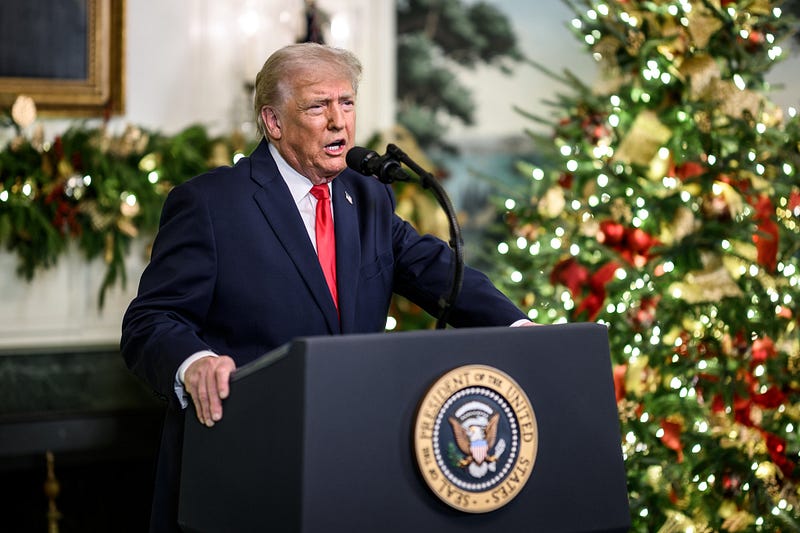
Presidents usually wait until January to tell the country how things are going. That’s what made Donald Trump’s address this week stand out. This wasn’t a formal State of the Union, but it was clearly meant to function like one. Less a speech for the moment than a marker for what comes next.
Trump wasn’t just defending his record. He was setting expectations. And in politics, expectations matter.
The speech rested on a simple idea: fix the basics first, then let the country breathe. Border enforcement, inflation, energy prices, wages — Trump framed these as foundational problems that had to be addressed before anything else could work. You can argue about the numbers or the language, but the governing philosophy is easy to spot. Order comes before expansion. Stability before ambition.
If you’re looking for clues about 2026, that framing is one of them. Trump seems to want the next election to be about results people can feel, not endless arguments about intentions or process. Prices at the pump. Grocery bills. Mortgage rates. Paychecks. These are the scorecards he’s inviting voters to use.
Another thing that stood out was how much emphasis he put on delivery. Not plans, not frameworks — delivery. Tax relief was talked about in terms of what families might actually save. Healthcare reform was framed around what people pay out of pocket. Energy policy was reduced to a blunt question: is your bill lower or not? Even the surprise payments to service members fit that pattern. Tangible benefits, now, not promises later.
That’s a risky strategy, but in a hopeful reading, it’s also a grounding one. When politics revolves around everyday costs instead of constant moral panic, the temperature can drop. Not because everyone suddenly agrees, but because people are arguing about real-world outcomes instead of abstractions.
The economic message points in the same direction. Trump leaned hard into tariffs, reshoring, and private-sector job growth. You can hear the 2026 strategy taking shape there. Factories opening, plants being built, investment announcements turning into actual jobs. Best case, those stories become local and visible, especially in places that haven’t had many good economic headlines in years.
Foreign policy was framed less as a crusade and more as containment. Fewer wars. Clearer deterrence. Less chaos bleeding into daily life. That kind of success rarely gets credit when it happens, but voters notice when the world feels calmer, when crises stop piling up every week.
What’s interesting is that the speech leaves Trump less room to hide. By speaking this way in December, he’s effectively daring the next year to prove him right or wrong. If inflation keeps easing, if housing costs come down, if wages keep inching ahead of prices, the argument writes itself. If they don’t, the contrast will be just as obvious.
There was also, buried under the familiar bravado, an invitation. Not a plea for unity, not a softening of tone, but an invitation to judge governance by outcomes instead of labels. Lower drug prices, more housing, safer streets, better pay — those aren’t partisan goals. They’re broadly shared ones, even if people disagree sharply on how to get there.
In that sense, the address wasn’t really about December or even about Trump alone. It was about confidence. Confidence that the country isn’t locked into decline. Confidence that course corrections are still possible. Confidence that politics can be about improvement rather than managed disappointment.
If this is the frame heading into 2026 — and if reality cooperates even halfway — the election may be less volatile than many assume. Hope has a way of cutting through cynicism when it shows up in ordinary places: receipts, rent statements, pay stubs. That’s the bet Trump seems to be making.
Will it pay off?
House Republicans certainly hope so. With the recent announcement of the retirement from Congress of Rep. Elise Stefanik, the margins of the GOP’s hold on the House is more tenuous than ever.
(Contributing writer, Brooke Bell)